

One way you can make sure that research includes your voice, is to contribute as a research participant.
Taking part as a research participant is one way to make sure your important voice is included in research findings, and making a difference.
The following research projects are either general calls for research participants, or are specifically seeking participants with diverse backgrounds.
Projects listed here have been approved by a relevant research ethics committee.
If you would like to list your research project, please contact us on kiaora@eraotearoa.org
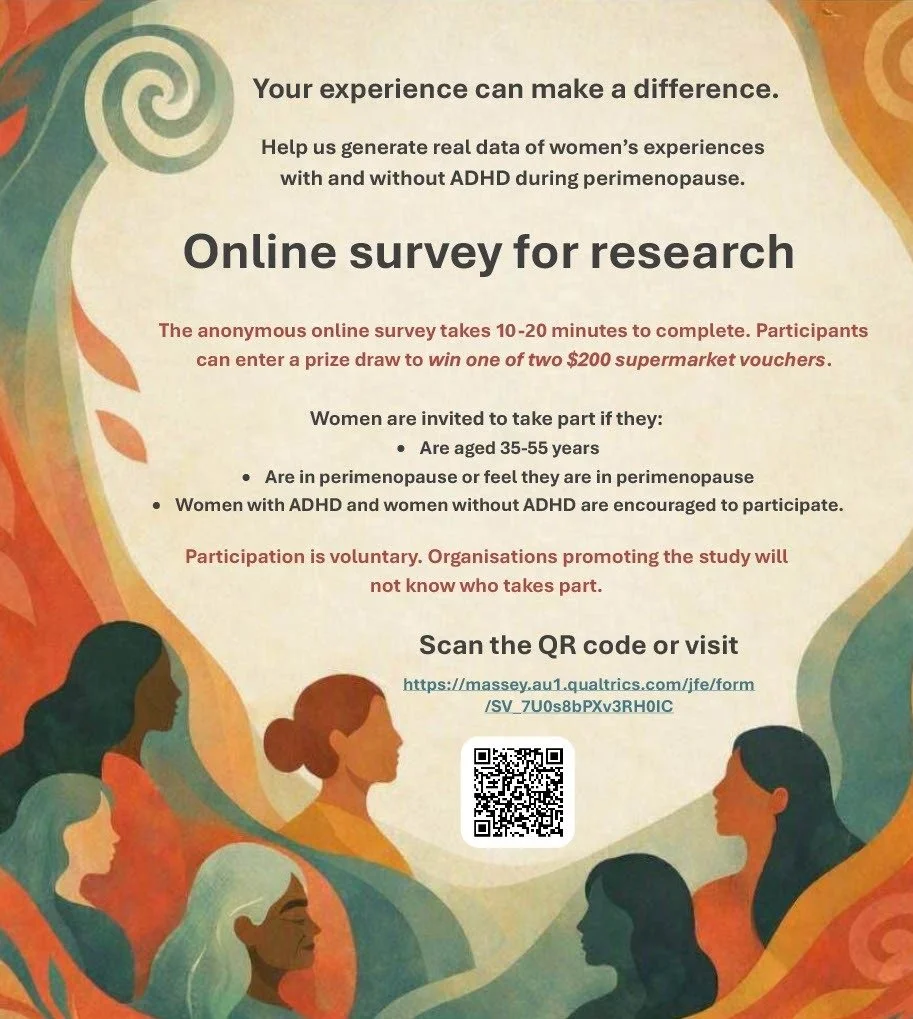
Women's experiences of perimenopause in Aotearoa New Zealand, looking at symptom differences between women with ADHD and those without
Kate Sutcliffe, a Master’s student in psychology at Massey University, is conducting research into women's experiences of perimenopause in Aotearoa New Zealand, with a focus on how this transition is experienced by women with ADHD compared to those without.
Kate is wanting to make sure her participants are representative of women in New Zealand.
Eligibility:
Aged 35-55 years
Are in perimenopause or feel they are in perimenopause
Women with ADHD and women without ADHD
What to expect:
10 to 20-minute survey
Entry to a prize draw to win one of two $200 supermarket vouchers.
This study has been approved by Massey University Human Ethics Ohu Matatika 1, Application OM1 26/41
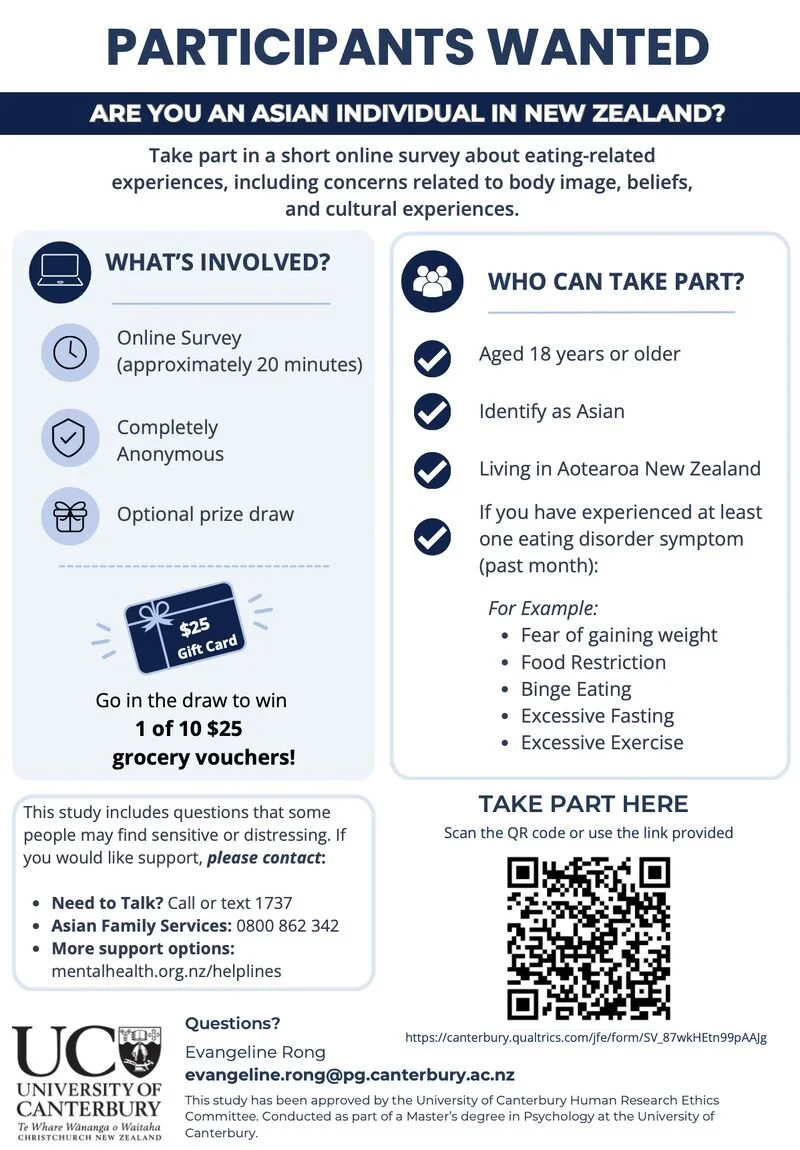
Examining the influence of cognitive and sociocultural factors in eating disorder symptoms among Asian individuals in Aotearoa New Zealand
Evangaline Rong, a Master of Science (Psychology) student in the School of Psychology, Speech and Hearing at the University of Canterbury, is conducting research to understand if beliefs and cultural experiences might influence eating-related concerns (for example, eating, weight, and body image).
The research aims to improve understanding of experiences and contribute to future research and culturally responsive support.
Eligibility:
Are 18 years or older
Identify as Asian
Currently live in Aotearoa New Zealand
Are proficient in English
Have experienced at least one eating disorder symptom (for example, restriction, fear of weight gain, or excessive fasting or exercise) in the past month.
What to expect:
20-minute survey
Entry to a prize draw to receive one of ten $25 grocery vouchers
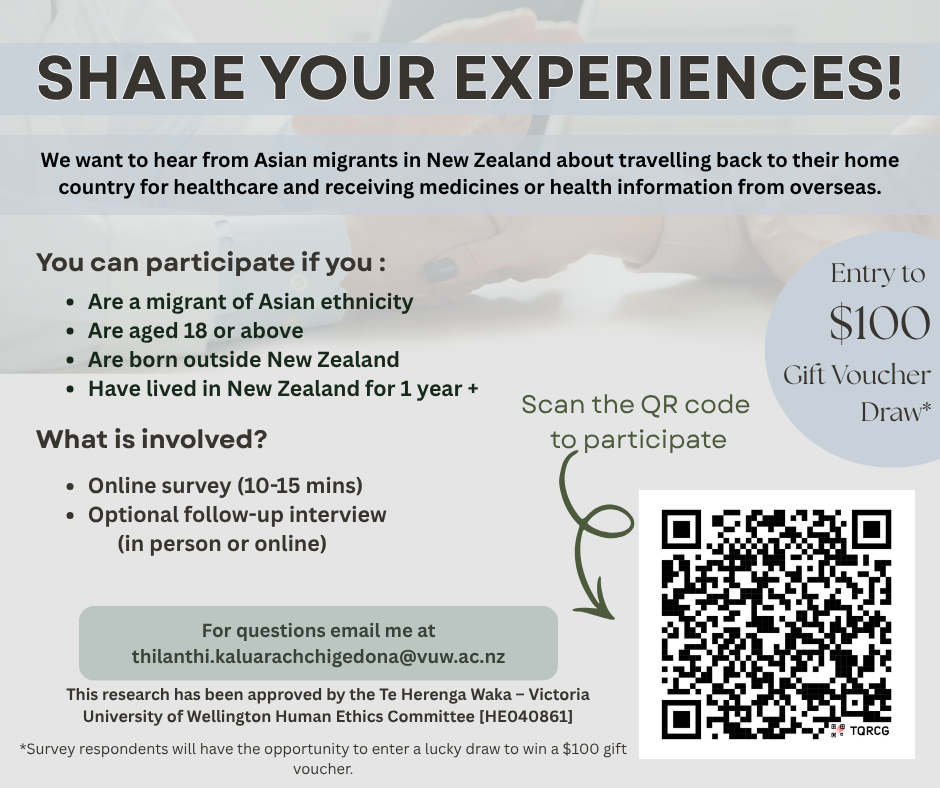
Cross-border healthcare use among Asian migrants in New Zealand
The study looks at Asian migrants' experiences of:
travelling to their home country to access healthcare
receiving health information or advice from their home country
obtaining medicines or medical supplies from overseas.
Eligibility:
Are a migrant of Asian ethnicity
Are aged 18 or above
Are born outside of New Zealand
Have lived in New Zealand for over 1 year
What to expect:
10-minute survey
Opportunity to take part in an optional follow-up interview
Entry to $100 gift voucher draw
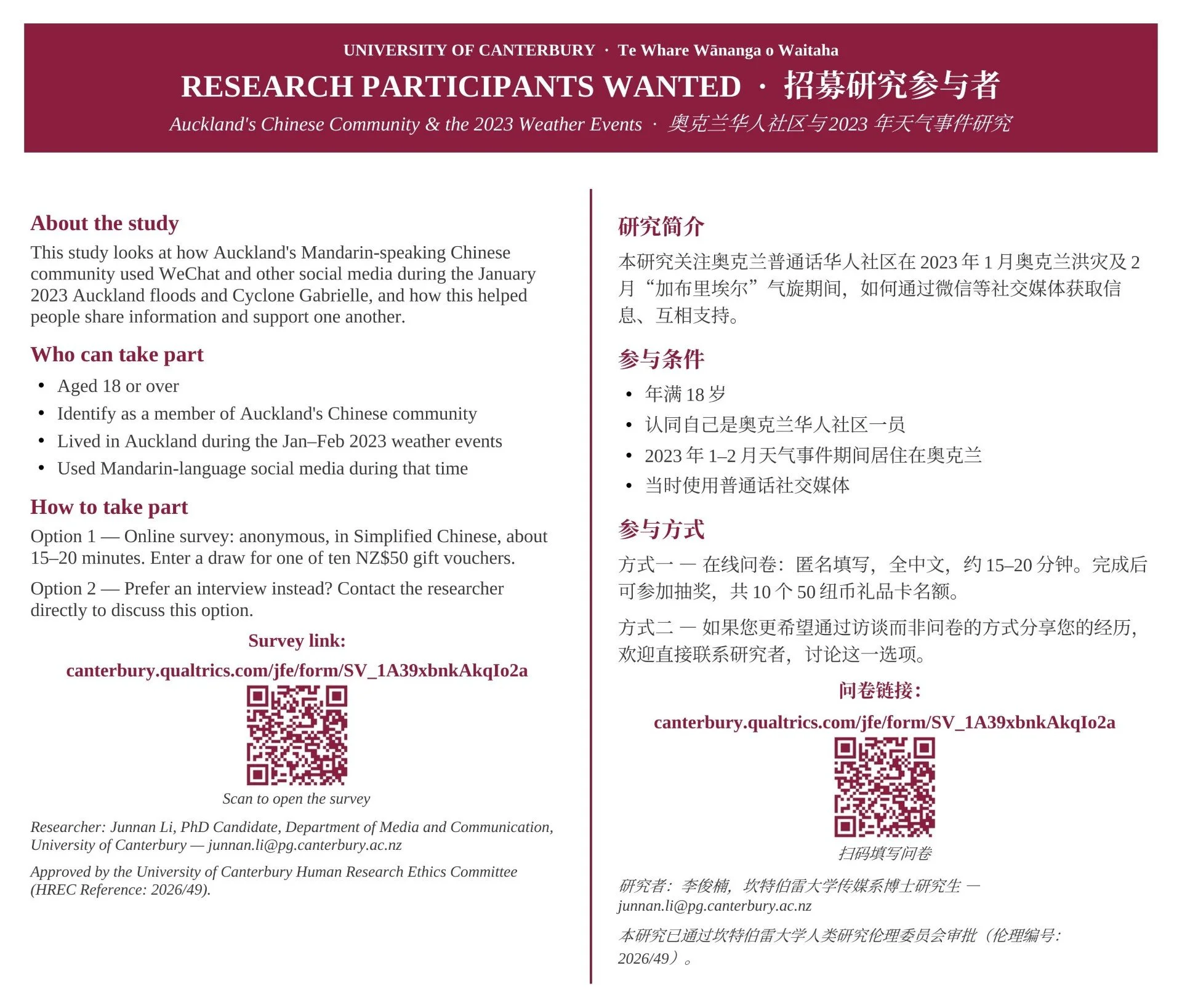
Auckland’s Chinese community and the 2023 North Island weather events
The study looks at how Auckland’s Mandarin-speaking Chinese community used WeChat and other social media during the January 2023 Auckland floods and Cyclone Gabrielle, and how this helped people share information and support one another.
Eligibility:
Aged 18 years and over
Identify as a member of Auckland’s Chinese community
Lived in Auckland during the January to February 2023 weather events
Used Mandarin-language social media during that time
What to expect:
15- to 20-minute online survey in Simplified Chinese. Can enter a draw for 1 of 10 $50 gift vouchers
OR
45- to 60-minute interview. Koha of $25 voucher
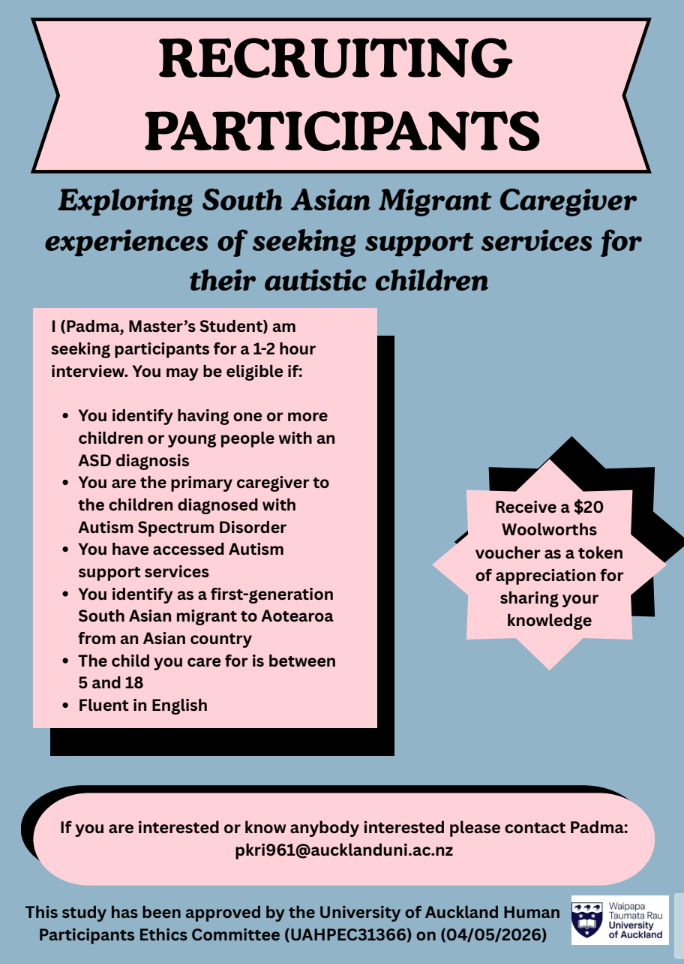
AUT Migrant and Refugee Health Research Centre (MRHRC) migrant and refugee wellbeing survey
The survey explores the wellbeing of migrant and refugee communities in Aotearoa New Zealand, and is available in eight languages (Arabic, Amharic, Burmese, Farsi, Hindi, Pashto, Spanish and Urdu) to make it as accessible as possible. Responses will help inform research and services that better reflect the needs of these communities.
Eligibility:
aged 18 years and older
reside in New Zealand
migrant or refugee who has settled in New Zealand for at least 6 months
What to expect:
45 minute survey
Can opt-in to participate in a draw
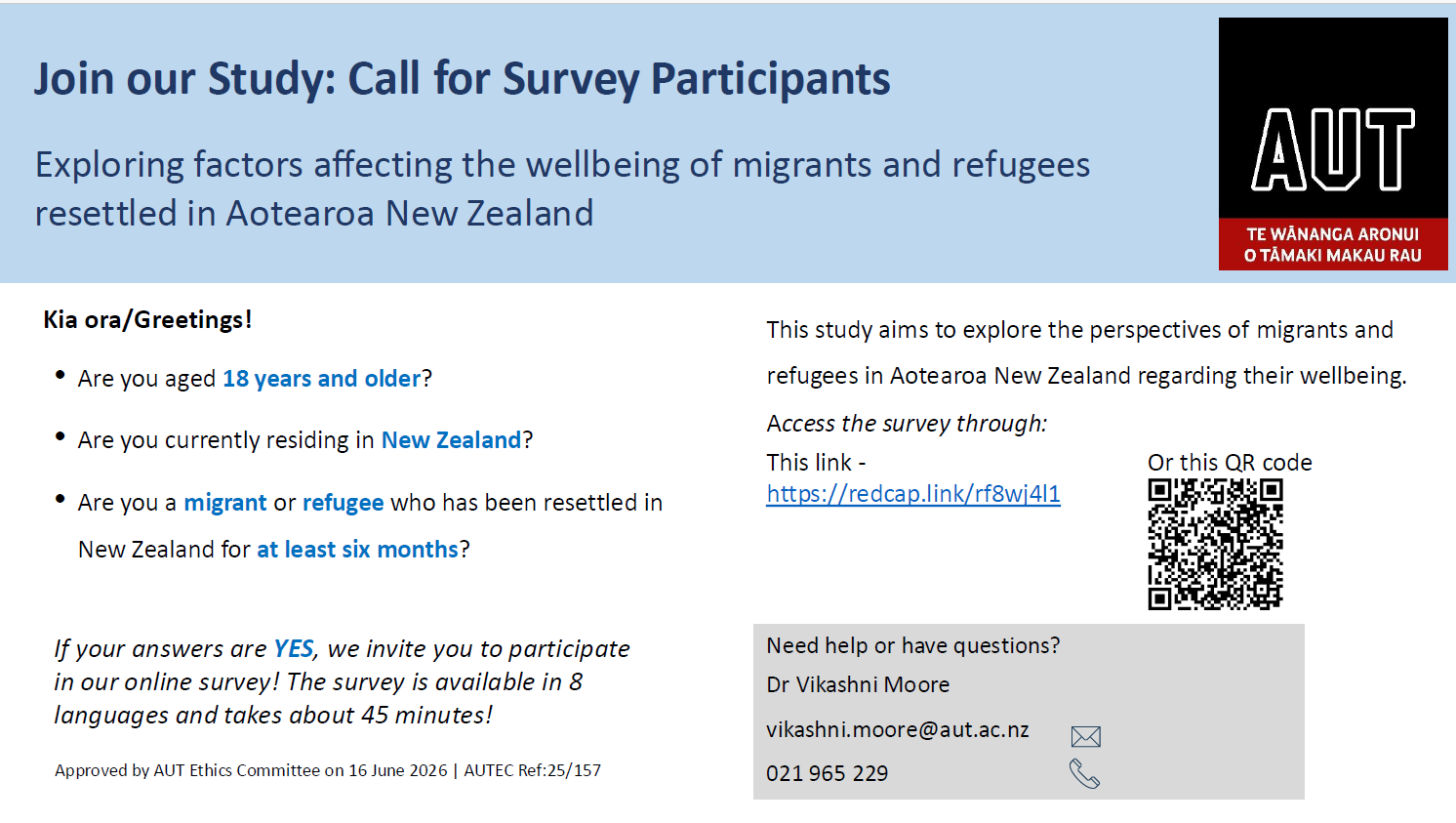
South Asian migrant caregiver experiences of seeking support services for autistic children
Padma Krisshnamurthi from University of Auckland is undertaking a study to understand the experiences of South Asian caregivers and parents in accessing and using support services for their autistic children.
Eligibility:
one or more children or young people (aged between 9 and 19) with an autism spectrum disorder (ASD) diagnosis
primary caregiver
accessed autism support services
identify as a South Asian migrant from an Asian country
fluent in English
What to expect:
1 - 2 hour interview (in-person or online)
$20 voucher as koha
Emotional and psychological impact of engaging with a virtual cultural environment
Nishadi Ariyasinghe from Victoria University of Wellington is undertaking a study to:
Explore emotional and psychological impact of engaging with a virtual cultural environment.
Assess how interactive cultural experiences influence identity creation and connectedness.
Identify challenges or barriers in adopting VR for social and cultural integration.
Eligibility:
first generation Sri Lankan migrant
adult (18+)
available for in-person participation at the Kelburn campus of Victoria University of Wellington
What to expect:
attend 3 sessions (around 30 minutes per session)
$20 voucher as koha

Creative research project to enhance the visibility, accessibility, and impact of Chinese New Zealand arts for Sinophone communities
Shiqi Ren (she/her) is a practitioner-researcher in literary translation and performing arts, currently pursuing a PhD at Te Herenga Waka—Victoria University of Wellington.
She is seeking participants for a creative research project exploring strategies to enhance the visibility, accessibility, and impact of Chinese Aotearoa/New Zealand arts for Sinophone communities.
From April to August 2026 she will run monthly literary salons (free and voluntary) designed to connect Sinophone individuals with local migration histories, sites, arts, and one another. Using her authorised Chinese translation of Nathan Joe’s Scenes from a Yellow Peril as a textual foundation, the salons will offer a space to learn, be creative, and contribute to discussions about mobility, identity, and belonging in Aotearoa.
Eligibility:
self-identify as being of Chinese heritage
can read literary excerpts in Chinese characters
available for in-person participation in central Pōneke | Wellington
What to expect:
attend single or multiple sessions
option to apply for next-phase theatre workshops (with koha)
opportunity for individual interviews (with koha) in 2026–27
total time commitment for a participant can range from 2 hours (attending a single salon) to over 40 hours (engaging in all three phases).

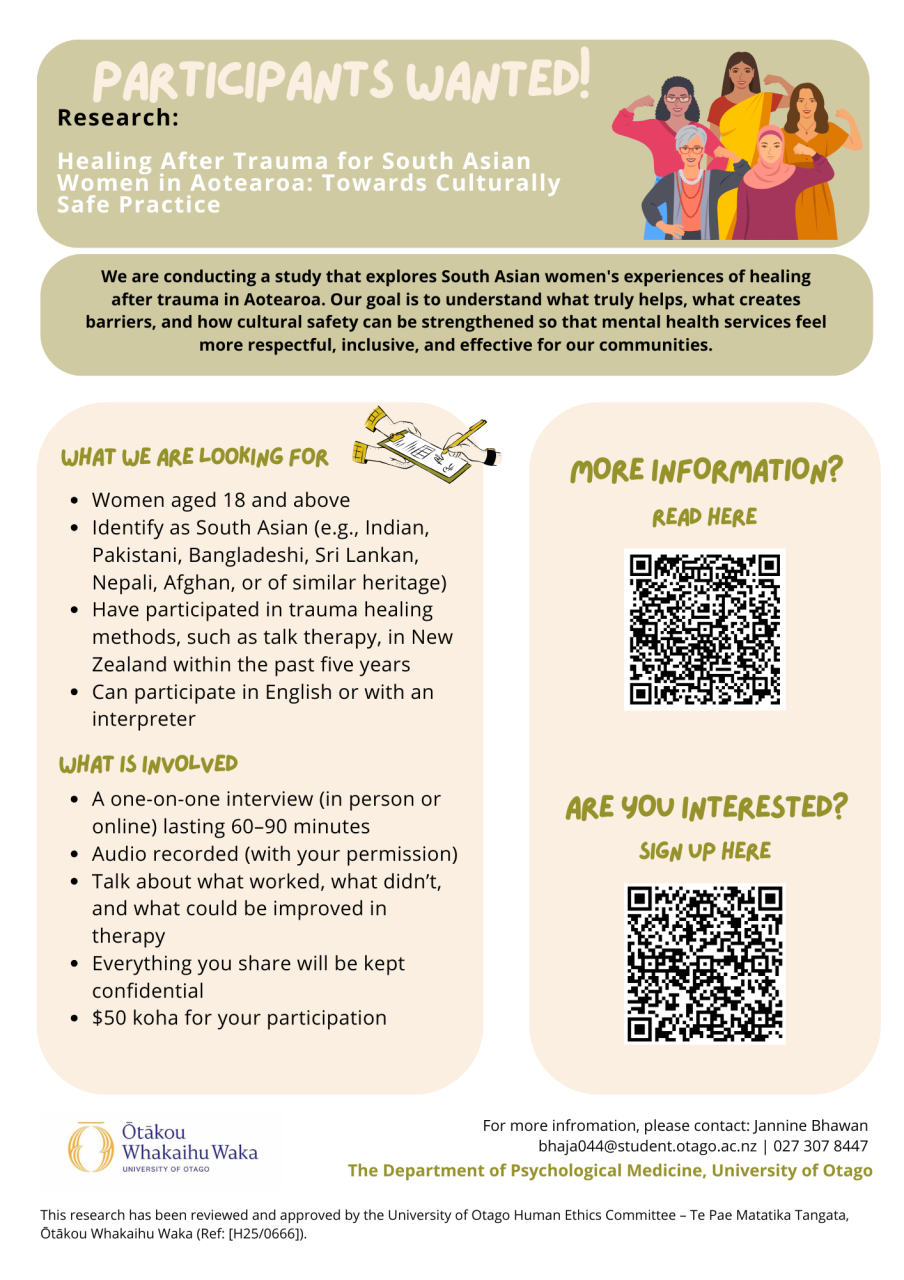
A study that explores South Asian women’s experiences of healing after trauma. The goal is to understand what truly helps, what creates barriers, and how cultural safety can be strengthened so that mental health services are more respectful, inclusive, and effective for communities.
Eligibility:
women aged 18 years or older
identify as South Asian
have participated in trauma healing methods in New Zealand within the past 5 years
can participate in the study in English or with an interpreter
What to expect:
one-on-one interview (in person or online)
$50 koha
Healing after trauma for South Asian women in Aotearoa
Functional Neurological Disorder: Testing a new treatment to improve movement and walking
The treatment combines non-invasive brain stimulation and physiotherapy to help people relearn how to walk.
Eligibility:
aged 18 years or older
have Functional Neurological Disorder
In Auckland
What to expect:
One day
4 short phone calls within 3 months of treatment
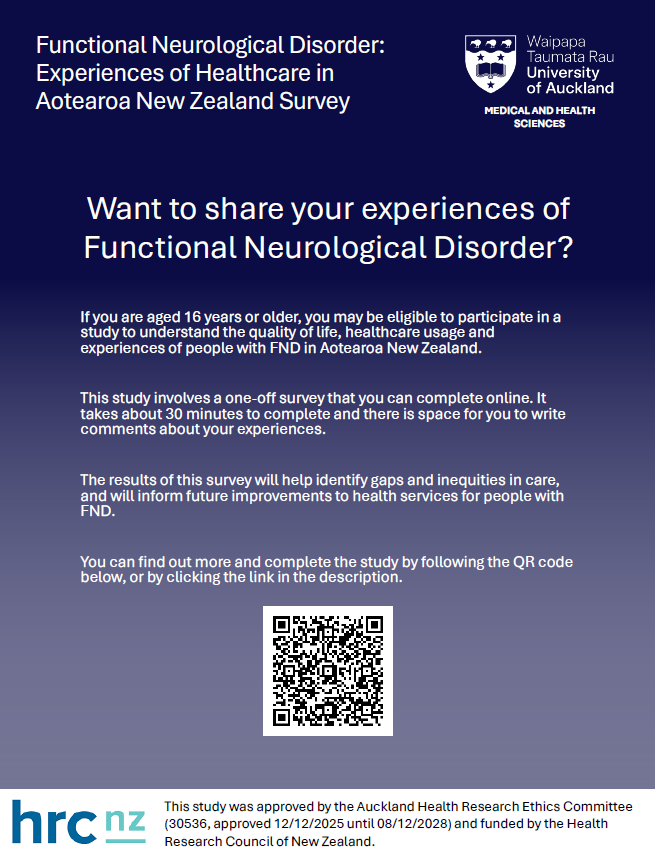
A study to understand the quality of life, healthcare usage, and experiences of people with FND in Aotearoa New Zealand. The results will help identify gaps and inequities in care, and will inform future improvements to health services for people with FND.
Eligibility:
aged 16 years or older
have Functional Neurological Disorder
What to expect:
online survey
30-minutes
Experiences of Functional Neurological Disorder
Can eye drops safely replace reading glasses in older adults?
From around age 40, most people start noticing blurry near vision (“presbyopia”). This happens because the lens in the eye gradually loses its ability to bring near objects into focus. Recently, the United States Food and Drug Administration has approved a new eye drop to treat presbyopia, known as Vuity.
The aim of this research is to understand the effects of Vuity eye drops on the structure or function of the tissues at the back of the eye, so that we can confirm it is safe for regular, long-term use.
Eligibility:
Based in Auckland
aged 40-55
habitually only wear reading glasses for near viewing (for example, computer work) with otherwise healthy vision.
What to expect:
a short-term and/or a longer-term study. Both studies will involve routine imaging and electrophysiology assessments.
The short-term study will involve 3 visits to the Grafton Optometry Clinic (each ~2 hours), where you will receive a one-off dose of Vuity in one eye.
The long-term study will involve using Vuity eye drops or your own reading glasses, each for 3 months at a time (6 months in total). You will be required to visit the Grafton Optometry Clinic on 4 separate occasions (each ~1 hour).
Up to $150 worth of petrol/supermarket vouchers as koha for taking part in each study.

Culture and agency: Developing a new lens on migration and App work
This study aims to investigate and highlight New Zealand temporary migrant experiences of finding work through or working for Apps or online platforms. Little is currently known about this area.
The research aims to focus on the role of culture and life experiences in shaping decisions around involvement in App-related work for individuals who have migrated to Aotearoa New Zealand.
Eligibility:
adult (18 years old and over)
migrated to New Zealand
hold a temporary visa (you are not a resident, permanent resident, or citizen)
have found work through or have worked for an App or online platform during the last 12 months.
fluent in English or Hindi.
What to expect:
1-hour online interview
$40 supermarket voucher

Cantonese language mainenance
New Zealand has a long history with Cantonese speakers, with the first arriving as gold miners and increasing numbers since the 1950s. In spite of the steady influx of Cantonese speakers very little is known about their language practices and attitudes. We want to find out how many people actually speak Cantonese and/or a related dialect, and how many have shifted away to English or another language.
We are interested in exploring the factors that have led to those language choices. We are also interested in investigating the attitudes people have towards Cantonese and whether participants feel the language is associated to their identity in New Zealand.
Eligibility:
18 years and older
speak Cantonese or a Cantonese-related dialect
have family with Cantonese, or Cantonese-related dialect, ancestry
What to expect:
15-20 minute survey
opportunity to go into a prize draw to win one of two $50 petrol vouchers

Community language teachers
Margaret Connelly, a PhD candidate at Victoria University of Wellington, is interested in the professional experiences of heritage language teachers, including those working in community contexts. (For the scope of this research, she is focusing on any language except the official languages of New Zealand.)
This research project involves talking to community language teachers about their professional experiences, covering three key topics:
how community and heritage language (CL) teachers experience the effects of things like class rules, teaching materials, their training, and the places they work;
how CL teachers see themselves as professionals in their language schools and communities;
what CL teachers think about their training and development, especially regarding how much it's needed, how available it is, how suitable it is, and how it affects their professional status and recognition.
The broad aim of the project is to help strengthen CL education in New Zealand.
What to expect:
Visits, interviews, and group discussions

Dose-response effects of nitrate-rich beetroot drink on blood pressure in adults with untreated high blood pressure
Reder Msalih is a Doctoral researcher at Massey University, and is a Registered Nutritionist (New Zealand). Reder is leading a randomised clinical trial on the effects of drinking nitrate-rich beetroot juice on blood pressure.
This study is being conducted by a multidisciplinary team of five academic supervisors from Massey University, Auckland, including nutrition, physiology, and clinical health experts.
Eligibility:
Based in Auckland
Between 30 and 75 years old
Have high blood pressure, or think you might
Are not taking blood pressure medication
Do not engage in intense exercise more than once a week
Do not have heart disease, stroke, or diabetes
Do not smoke or vape
What to expect:
4 visits after eligibility check
drink a glass of beetroot juice per visit
non-invasive measurements (for example, blood pressure measurement)
provide blood samples
$50 voucher per visit = $200 for 4 visits
The study has been approved by the Health and Disability Ethics Committee (HDEC #2025 EXP 19717) and registered with the Australian New Zealand Clinical Trial Registry (ACTRN12625000489493).

Acculturation experiences of skilled South Asian immigrants
Ziaul Jewel is a Massey University doctoral student and a Bangladeshi immigrant living in Aotearoa. Ziaul is interested to learn more about South Asians’ motivation to relocate, resettlement challenges, and its effect on their lives in Aotearoa.
Eligibility:
from India, Sri Lanka, Pakistan, Bangladesh, and Nepal. This excludes individuals of Indian heritage who have migrated to Fiji, South Africa, or any other place
have immigrated voluntarily to Aotearoa
have relocated to Aotearoa within the past 10 years and have resided at least 2 years in Aotearoa
currently employed.
What to expect:
confidential 1 hour interview
$50 gift voucher

This study has been approved by the Massey University Human Ethics Committee for 3 years from 16 September 2024 (OM2 24/41)
Language transmission in multilingual families
A multi-country study by Karlstad University, Sweden, in conjunction with Griffith University, Australia, Massey University, New Zealand, and Nanyang Technological University, Singapore seeks to investigate the environment in which multilingual parents raise their children and what might impact on parents’ decisions to transmit, or not, their home languages to their children.
Eligibility:
Aged over 18 years old
live in a family in which more than one language is used or could be used, or
if you are or have been a parent or primary carer of at least one child over 2 years of age
if you were yourself raised or exposed to more than one language at home as a child.
What to expect:
web-based questionnaire
20-30 minutes, in one session

